Hatching Underway!
4/26, 11:48 AM:
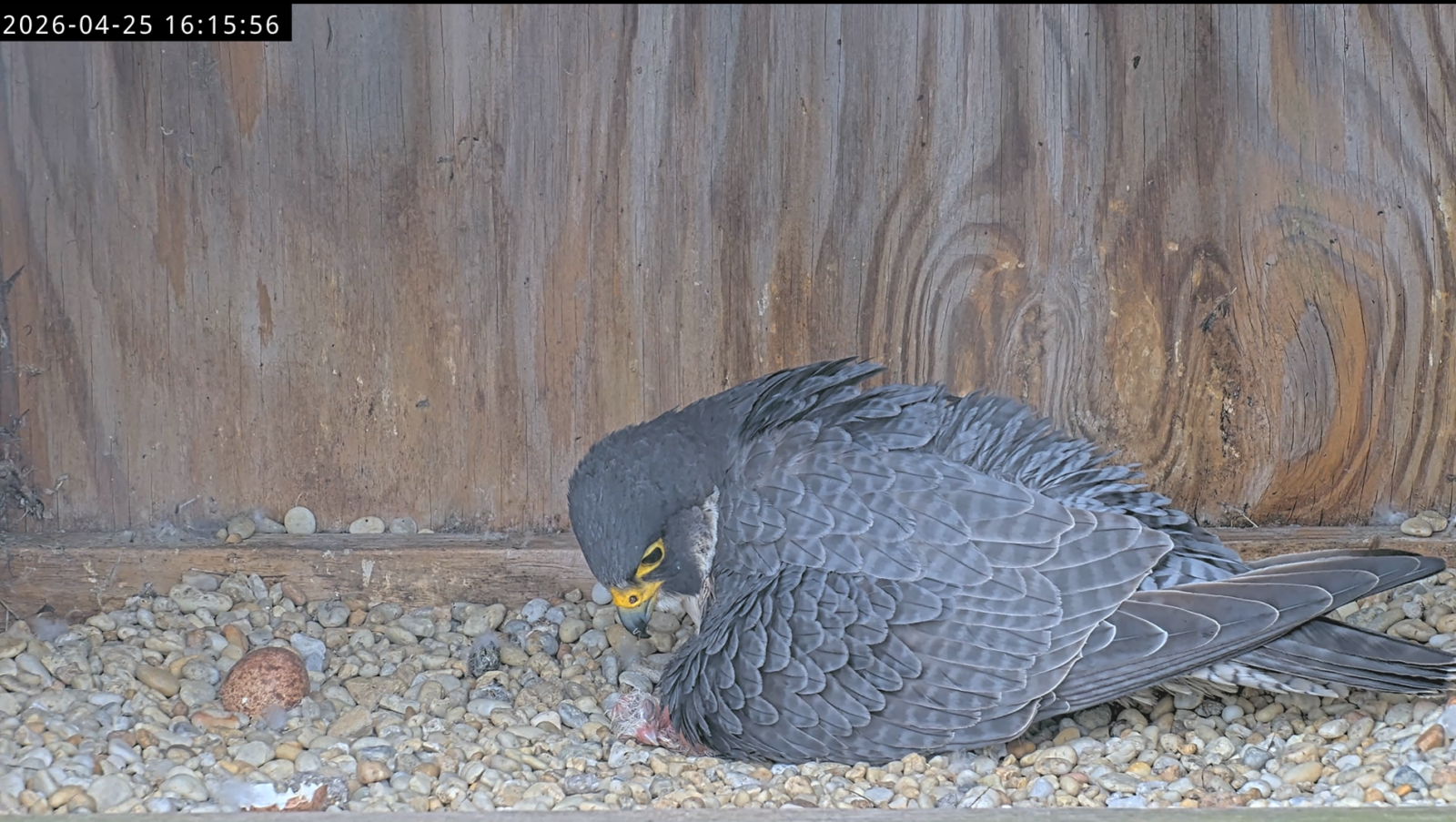
We now have three chicks in the nest as the third egg hatched yesterday around 4 PM. Shortly after hatching, chicks will have a lot of visible, pink skin and wet down feathers. These feathers dry with time and in just a few hours they will look very different with a fluffy, white almost cotton ball-like appearance.
As of this writing we are still awaiting the fourth egg to hatch. Hatching is an incredibly exhausting activity for a chick, and as such it can take a chick anywhere from a few hours to a few days to completely hatch. In the periodic glimpses that we get of the fourth egg, it appears to be making progress and we hope to see the chick fully emerge today.

The third chick, minutes after hatching, is visible under the wing of 95/AK
4/25, 8:52 AM:
Two eggs have hatched. The first chick appears to have hatched around approximately 8 PM on the evening of 4/24 with the second chick hatching sometime in the early morning hours of 4/25. Keep watch and you may catch the next chick hatch, or see the current chicks receive a meal.

59/BM arrives to the nest box where two chicks have hatched. A third chick is nearly out of the egg as evidenced by the “zippering” on the eggshell in the front.
4/24, 10:34 AM:
After 32 days of incubation, we can expect to see signs of hatching start this weekend! Peregrine falcon eggs are incubated for roughly 33-35 days which means we should expect to see our first signs of hatching around April 25th-April 27th.
Keep your eyes peeled during incubation exchanges for pips! A pip is a small crack or hole that chicks hammer through the internal membrane and external shell of the egg. Once a pip is observed on an egg, it means the chick inside has begun hatching and if all goes well, will be out of the egg within the next 12-48 hours. And, if you have the audio on, you may even be able to hear ‘peeping’ from the chicks hatching within the eggs.
We will be watching closely and continue to report on any newly hatched chicks!

The male peregrine falcon, 59/BM, comes into the nest box for his turn to incubate the eggs.